
Search Specys
Search products and public user profiles.
Search products and public user profiles.
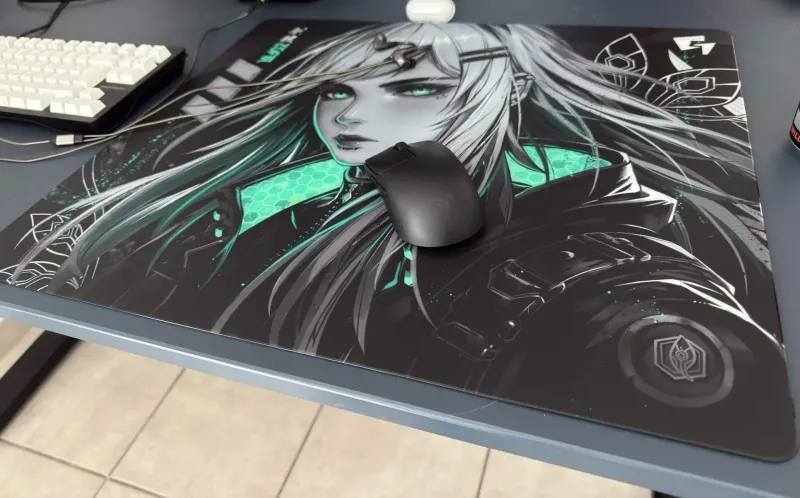
Disclosure: The Zofia was actually a birthday gift from @tekkusai (founder of GLSSWRKS). Huge thanks for that! That said, this review is 100% unbiased and reflects my genuine, honest opinion. When looking for a glass mousepad, online reviews can often be misleading. One reviewer calls a surface uncontrollable, while another calls it too slow. As always in the mousepad community, context is everything: without disclosing exact specs, skate pairings, and manufacturing details, surface impressions lose half their value. Here is my full review of the GLSSWRKS Zofia (limited to 4,500 units), strictly compared to my previous main, the GLSSWRKS Polarity . Setup & Baseline Specs To keep variables completely consistent, all testing was performed on: Mouse: Ninjutso Sora V3 Skates: Included Zofia GhostGlides Hardened PTFE Dots (6.5mm × 0.72mm with buffering layer) Display: 360Hz OLED Games Tested: Apex Legends , Valorant , Overwatch Technical Specifications Overview Dimensions: 525 × 450 mm (XL format) Glass Thickness: 1.1 mm Total Thickness: 2.25 mm (including base) Glass Material: NSG Glenova Aluminosilicate Glass (Japan) Tempering: Vacuum Ion Exchange process Etching: Isotropic Chemical Wet Etching (HANA × Polarity hybrid texture) Coating: Ion Assisted Deposition (IAD) Oleophobic & Hydrophobic Coating Base: Custom Teal Silicone (Mixed matte & glossy suction grid) Material & Build Quality 1. 1.1mm NSG Glenova Glass & Vacuum Ion Exchange Instead of standard soda-lime glass or thermal tempering (which can distort thin glass), GLSSWRKS uses 1.1mm display-grade NSG Glenova aluminosilicate glass. It undergoes a Vacuum Ion Exchange process , replacing sodium ions with larger potassium ions. Durability: 4–6x stronger than standard glass with high impact/scratch resistance. Flexibility: Allows the 1.1mm sheet to maintain structural integrity without snapping under minor stress. Optical Clarity: Exceptional visual sharpness without the cloudy distortion seen on thicker glass pads. 2. Surface Texture & IAD Coating The texture is chemically wet-etched, creating an isotropic surface without dead zones. It’s a hybrid profile combining the jagged peaks of the HANA with the overall layout of the Polarity. IAD Coating: Unlike thermally baked coatings that degrade over time, the oleophobic/hydrophobic layer is applied via Ion Assisted Deposition—bonding it atomically to the glass. Skin Compatibility: Sweaty arms won't stick, making an arm sleeve optional for most users. 3. Base & 2.5D Beveled Edges The pad features a flat 2.5D / 45° bevel edge that feels seamless against your arm due to the ultra-thin 2.25mm total profile. The Teal Silicone Base utilizes alternating matte and glossy sections to instantly lock onto the desk without trapping air bubbles. Main Comparison: GLSSWRKS Polarity vs. Zofia Having mained the Polarity prior to the Zofia , it served as my baseline for top-tier glass pads. Polarity (8.5 / 10) : An incredible pad, but for my personal preference, it was still slightly too fast . Fast flick-stops and micro-adjustments required extra effort to avoid minor overshooting. Zofia (10 / 10) : The Zofia fixes the exact friction dynamic I was missing. The HANA-inspired micro-texture provides noticeable stopping power and stability, while maintaining low initial static friction. In-Game Performance 1. Tracking Heavy ( Apex Legends & Overwatch ) On a 360Hz OLED panel, visual motion clarity is instant, meaning any micro-jitter in your hand shows up immediately on screen. The Zofia delivers controlled dynamic tracking. When enemies abruptly change strafe direction, the texture feedback lets you instantly stop and re-track without twitching or over-adjusting—a control level that was harder to maintain on the faster Polarity. 2. Tactical Precision ( Valorant ) Tactical shooters are usually challenging on glass due to the stopping power required for crosshair placement. The Zofia handles Valorant* surprisingly well. The added surface feedback over the Polarity allows for steady micro-corrections when holding tight angles. Mouse, Skates & Z-Axis Friction Interaction Using the Ninjutso Sora V3 with the included GhostGlides hardened PTFE dots : Uniform Glide: The skate-to-surface interaction feels 100% consistent across the entire pad. Z-Axis Friction (Grip Pressure): The surface texture responds to down-pressure. Intentionally pushing down slightly into the pad during high-stress encounters adds an extra layer of controllable slowdown without feeling muddy. Audio Feedback: The buffering layer on the included dots keeps acoustic feedback very quiet despite the textured glass profile. Verdict & Final Score GLSSWRKS Polarity : 8.5 / 10 (Great, but slightly too fast for my taste) GLSSWRKS Zofia : 10 / 10 (The ultimate sweet spot of glass smoothness and tactile control) If you loved the premium quality of the Polarity but wanted more control, stopping power, and a thinner desk profile without sacrificing glass smoothness, the Zofia is an absolute masterpiece. An easy 10/10 and my new daily main.